
Protecting sensitive information in mission-critical environments.
Secure cross-domain data exchange across classifications.
coalition environments and tactical infrastructures.
Protecting sensitive information in mission-critical environments.
Modern warfare is won and lost on data. Data interoperability is the lifeblood of the modern battlefield — the ability to get the right information, to the right people, across every domain, classification, and coalition network, at the speed of decision.
Modern defense operations require data that flows freely across domains, nations, and classifications — while remaining under sovereign control at every step.
NVD operationalizes controlled interoperability: data is instantly accessible to every authorized recipient across any domain or classification, yet invisible and irrevocable to everyone else — anytime, anywhere, without the need for trusted networks.
Designed to resolve threats from an attacker’s perspective
Recognized as Strategically Important to Germany
NVD is capable to resolve over 80% of today’s cyber threats defined in the BSI IT Grundschutz-Compendium — assessed following two years of rigorous evaluation by the German Armed Forces.
Validated in Live Military Exercises
Proven Under Operational Conditions
NVD has been tested and validated in real Bundeswehr and NATO military exercises, demonstrating operational effectiveness in contested and classified environments.
Winners of the 2022 NATO Innovation Challenge
Protected Data Management on Unsecure Componentsn
Selected by NATO Allied Command Transformation (ACT) for solving the alliance’s core interoperability challenge: enabling resilient, secure data infrastructure across untrusted and unsecure networks.
Based on NATO standards—and beyond
DCS Maturity Level 3
Complies with the current DCS STANAGs (4774/4778, 5636) and also offers solutions for new standards regarding DCS capability for streaming and tactical data.
The Operational Challenge: Security vs. Interoperability
Defense systems span multiple classifications, nations, and technical domains. Today’s security architectures force a trade-off: increasing interoperability weakens security, while stronger security blocks operational data flow.
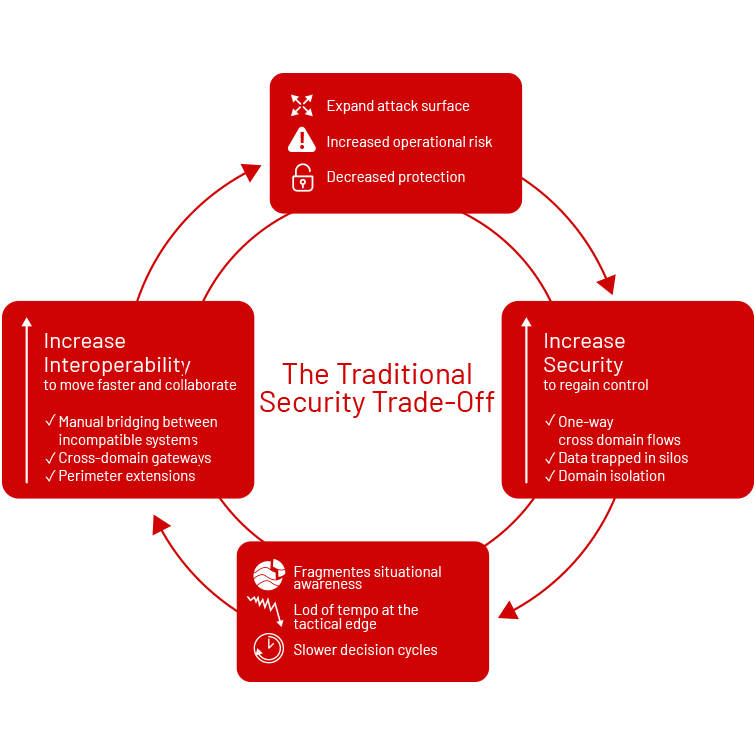
As operations become more connected and time-critical, these limitations break the operational loop. And while the taken measures attempt to contain risk, they reinforce fragmentation and prevent secure, scalable interoperability.
The Strategic Direction: Data-Centric Security and Zero Trust
To resolve the conflict between security and interoperability, defense organizations are converging on a clear target state: security that follows the data, not the infrastructure.
Rather than protecting networks, systems, or locations, protection and control are applied directly to the information itself — across its entire lifecycle.

Zero Trust
✓ Review each request
✓ Continuous identity verification
Access Control

Data-Centric Security
✓ End-to-End Encryption
✓ Protection Built Into the Data
Data Security
Zero Trust
✓ Review each request
✓ Continuous identity verification
Access Control
Data-Centric Security
✓ End-to-End Encryption
✓ Protection Built Into the Data
Data Security
Zero Trust strengthens access control. Data-Centric Security (DCS) strengthens the protection of the data itself.
Together, these two approaches define the direction of modern security architectures in the defense sector.
As a result, DCS and Zero Trust remain strategic objectives — but not yet structurally embedded capabilities.
- Zero Trust stops at users and systems — data becomes exposed once access is granted
- The current DCS maturity level is just providing data-labeling and binding capabilities to allow data flows between domains. Neither encryption at-rest or in-use, nor data lifecycle protection is standardized yet
- DCS for tactical or streaming data is not yet defined
- Centralized key management creates single points of failure
- Coalition operations require sovereign control over encryption and revocation
- Degraded and contested environments break centralized architectures
As a result, DCS and Zero Trust remain strategic objectives — but not yet structurally embedded capabilities.
Political coordination alone is not enough to close this gap. A security layer is needed that integrates protection directly into the data itself.
Political coordination alone is not enough to close this gap. A security layer is needed that integrates protection directly into the data itself.
From Strategy to Operational Capability: The NVD Data Layer
The strategic direction defines the target state – one protected infrastructure with a logical layer to exchange data seamlessly across domains and different security classifications.
The NVD Data Layer makes it operational.
Instead of relying on trusted networks, centralized key servers, or policy enforcement points, NVD embeds protection directly into the data object itself.
Data becomes non-visible by default.
NVD provides solutions for the needed capabilities planned for future DCS capabilities already now:
- Data lifecycle encryption
- Distributed key management
- DCS capabilities with no overhead for tactical data and even for binary data formats such as Variable Message Format (VMF)
- Encryption and sharing capabilities for streaming data, like video, audio, Infrared etc.
- Robustness and efficiency to operate even in DDIL environments Robustheit und Effizienz für den Einsatz auch in DDIL-Umgebungen
NVD can only be reconstructed and used when cryptographic conditions are satisfied — independent of where it is stored, processed, or transmitted.
This shifts security from infrastructure control to data control.
When protection is embedded directly into the data, a new architectural layer emerges — one that sits between infrastructure and applications.
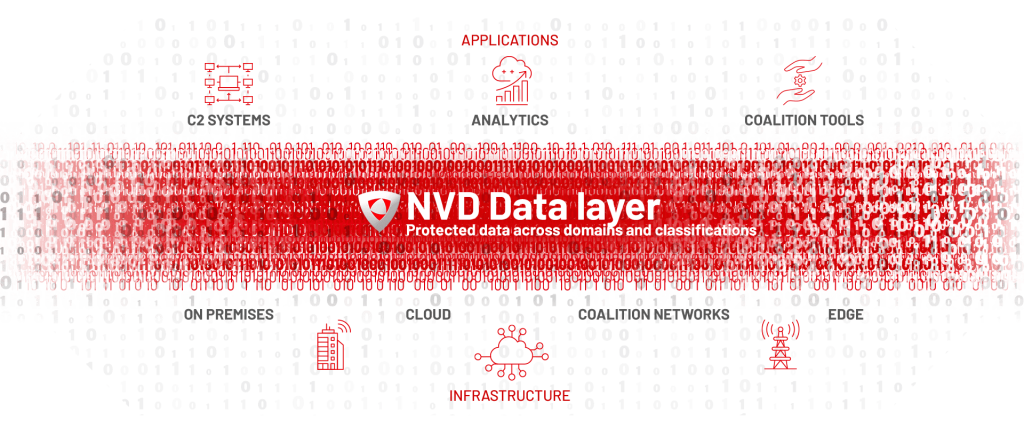
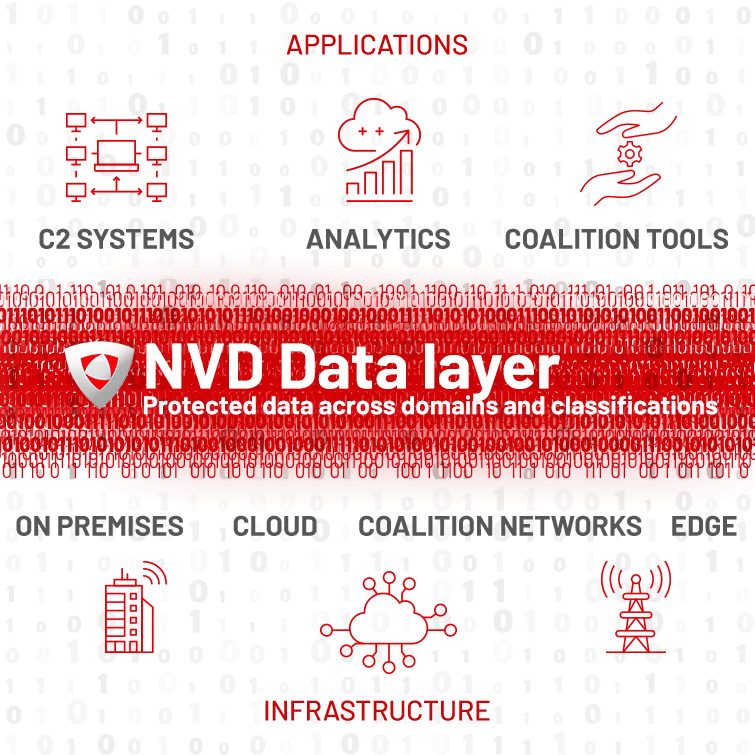
This layer:
- Separates security from network boundaries
- Allows data to move without being exposed
- Maintains sovereign control across domains
However, the main goal is the operative value by having any kind of information immediately available, shortening the time from sensor to effector.
This includes the ability to establish a real-time dross-domain Common Operational Picture (COP), leveraging all sources needed to take the right decisions.
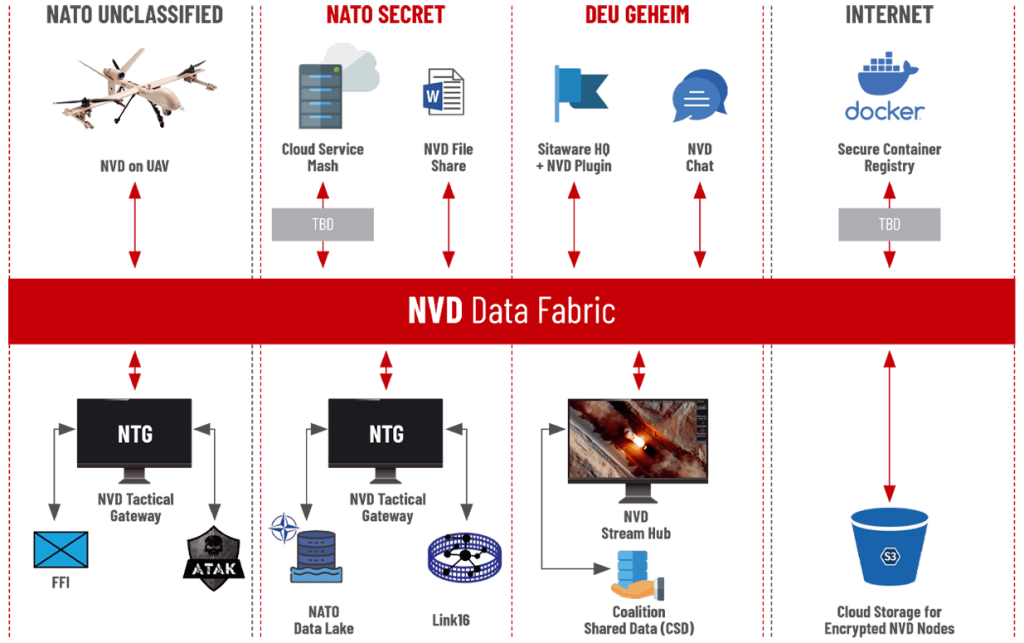
The following drawing illustrates the NVD Data Layer and the services which are already available to exchange information seamlessly across domains. The services depicted also prove that NVD is data format agnostic, allowing to protect everything binary in an efficient manner, from huge video streams, over small tactical data, to whole application setups within container.
Deploying the NVD Data Layer in Defense
The NVD Data Layer is not a standalone system.
It is a security foundation deployed through mission-specific components to add operative value.
Each component extends the same data-centric protection into different operational use case.

NVD Tactical Gateway
Enables controlled data exchange across classification levels and coalition boundaries – without exposing content in transit or at rest.
Designed for
selective release,
sovereign control
and tactical-edge
deployment.
NVD Siteware HQ Plugin
Embeds data-centric protection directly into operational command systems, allowing mission data remain secure inside existing workflows.
Designed for
trusted
collaboration,
without altering
operational processes.

NVD Streamhub
Protects live sensor, ISR and operational data streams while enabling controlled redistribution across domains and partners.
Designed for high-tempo
operations,
ISR dissemination,
and coalitionsawareness
within coalitions.
Every use case operationalizes the same principle:
security embedded in the data — independent of infrastructure, domain, or trust boundary. Efficient, flexible, yet controlled exchange and usage of information.
And this is just the beginning. Or defined target is to get NVD on any sensor, any device, any vehicle, any system to get the most out of all information sources available – without operative risk!
Other use cases


ENERGY & CRITICAL INFRASTRUCTURE
Secure data across legacy systems, grid operations
and hybrid cloud environments.
Explore NVD in ENERGY

Are you interested?
Please feel free to contact to us.