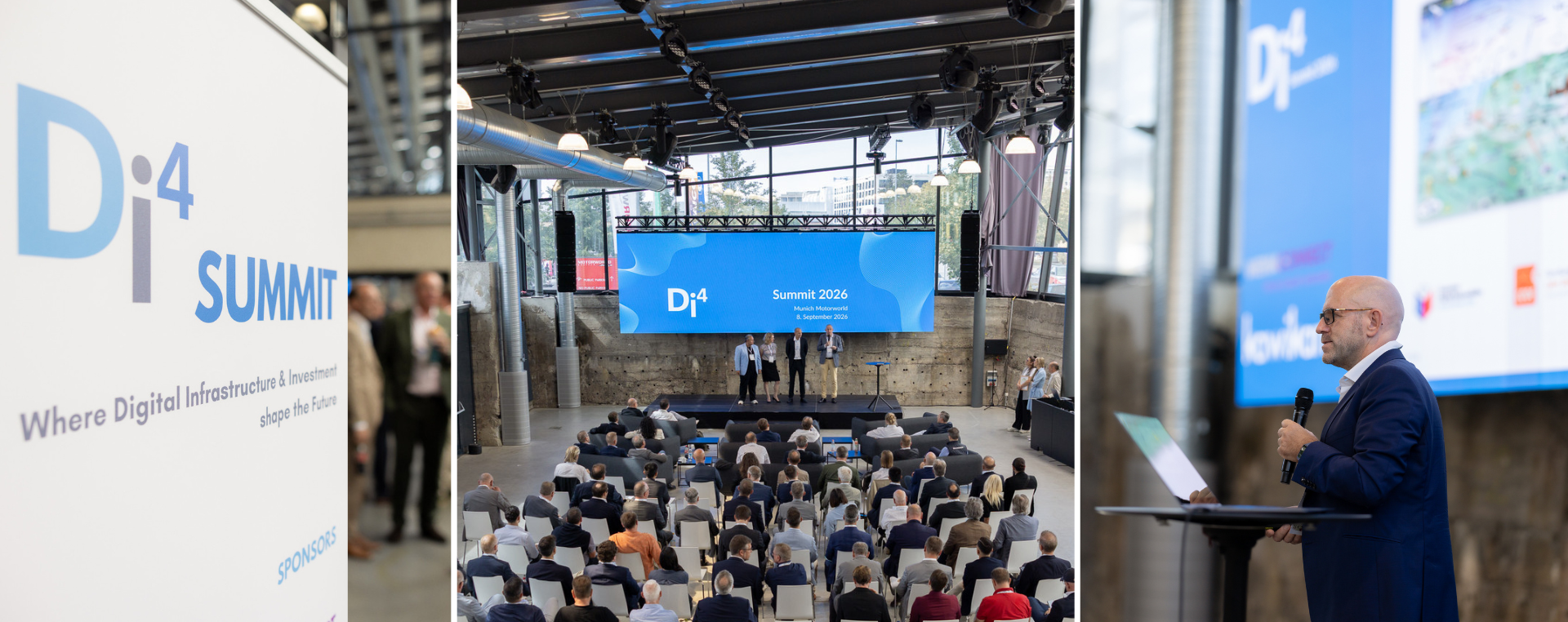
How can Europe generate long-term value from the current boom in AI, data centers, and digital infrastructure? And is control over infrastructure really still the key competitive advantage?
SECLOUS Managing Director Kai Rehnelt posed these questions at the Di4 Summit 2026 on September 7, 2026 , at Motorworld in Munich , as the focus of his presentation titled “Whoever controls the infrastructure controls value creation—is that still true?”
The key message: Germany and Europe should seize this opportunity now to evolve from slow, bureaucratic followers into innovative and bold trailblazers.
What We Can Learn from the Defense Sector
A fundamental shift in thinking is currently taking place within NATO: from the previous “need to know” principle to “need to share.” Success will depend not on keeping information under wraps, but on its most comprehensive—yet controlled—use.
Traditional perimeter security is increasingly reaching its limits. Instead, data interoperability is becoming the key factor.
In a military context, information across the entire cloud continuum—from the cloud to the fog to the edge—must be exchanged between different nations and domains such as the Army, Air Force, Navy, Cyber, and Space. At the same time, this data has different security classifications.
The real challenge, therefore, lies in exchanging data in a controlled manner between all these areas—that is, enabling secure and controlled cross-domain transitions. This is a challenge that can certainly be applied to the civilian economy—for example, to the increasing convergence of IT and OT.
Islands of knowledge become networks of knowledge
Therefore, the goal for Germany and Europe should not be to lock away data. Rather, we must make better use of existing knowledge.
This requires common standards for the secure exchange of data between companies, research institutions, data centers, and government agencies. Data-centric security and Zero Trust make it possible to tie control directly to the data—regardless of where it is stored, processed, or transmitted.
In this way, today’s silos of knowledge can evolve into cross-organizational knowledge networks. This opens up new opportunities—especially for small and medium-sized businesses and research institutions—to leverage existing data, harmonize processes, and create specialized offerings.
This can also make the infrastructure itself more decentralized: computing doesn’t necessarily have to take place in just a few large data centers. Specialized edge and micro data centers can bring computing power closer to energy sources, businesses, and applications. And with them, AI also moves closer to the actual users.
Complexity as an Opportunity for Europe
The growing reliance on AI and digital infrastructure brings new risks—but that is precisely where a major economic opportunity lies.
Europe does not need to build the next “me-too” technology stack. Differentiation can arise where today’s technologies have weaknesses in security, control, and traceability.
These include, for example, confidential computing and multi-party computation, isolated systems, containerized and controllable AI environments, as well as specialized AI solutions whose decisions remain transparent.
Above all, we need “Security by Default”—not as a marketing promise, but implemented through concrete technologies, standards, data-centric security, and zero-trust architectures.
Europe’s opportunity, therefore, does not lie in isolating data, but in bringing it together securely. After all, in the future, value will be created where infrastructure, knowledge, and data can be interconnected in a controlled manner.